The high temperature, high humidity and strong sunshine in tropical regions pose special challenges to the construction of concrete mixing plants, which require systematic optimization from site selection and layout, equipment selection, production management to environmental protection. The following systematically explains the key requirements and implementation rules for station construction in combination with industry standards and engineering practices.
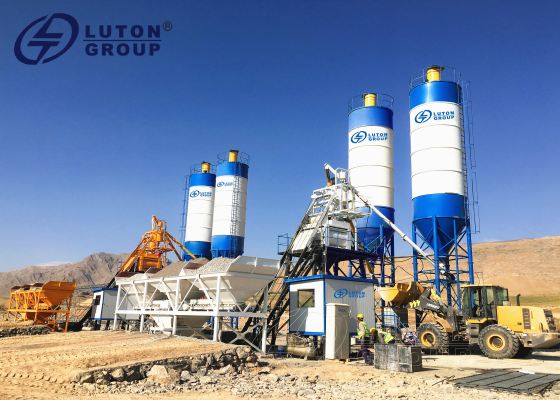
1. Site selection and layout requirements
(I) Geographical environment selection
Terrain conditions: Prioritize areas with higher terrain and smooth drainage to avoid water accumulation in low-lying areas. For example, when selecting the site for the Hainan Ring Island High-speed Railway Mixing Station, geological radar detection was used to avoid areas with too high groundwater levels.
Transportation facilities: The distance between the mixing station and the construction site should be controlled within 10 kilometers, with a road slope of ≤8% and a turning radius of ≥15 meters to ensure the traffic efficiency of concrete transport vehicles.
Safety distance: Keep a distance of ≥500 meters from sensitive areas such as residential areas and schools, and a distance of ≥100 meters from dangerous sources such as high-voltage lines and gas stations.
(II) Functional zoning planning
Production area: A dual-machine parallel forced mixer layout is adopted, with a single machine capacity of ≥120m³/h, a mixer spacing of ≥8 meters, and an independent dust removal system.
Material storage area: The sand and gravel silo adopts a steel structure scaffolding + lightweight roof design, with a roof height of ≥8 meters and a 3% slope drainage. The cement tank foundation adopts reinforced concrete expanded foundation, and the anti-overturning coefficient is ≥1.5.
Auxiliary facilities area: set up three-level sedimentation tanks (volume ≥50m³), vehicle washing area (equipped with high-pressure water gun) and test room (constant temperature 20±2℃).
2. Equipment configuration standards
(I) Selection of core equipment
Mixer: Use a twin-shaft forced mixer equipped with a composite ribbon mixer to increase mixing efficiency by 30%. Motor power ≥90kW, equipped with a water cooling system.
Metering system: Use a three-scale structure for powder (cement, fly ash, and mineral powder are measured independently), with an accuracy error of ≤±1%. Aggregate measurement uses a dynamic compensation algorithm with a dynamic accuracy of ≤±2%.
Temperature control system: Configure a chiller (cooling capacity ≥50kW) and an aggregate precooling device, mixing water temperature ≤15℃, and aggregate temperature ≤30℃.
(II) Environmental protection equipment
Dust removal equipment: A pulse back-blowing dust collector is installed on the top of the powder bin, with a filtration efficiency of ≥99.9% and an emission concentration of ≤10mg/m³.
Noise reduction measures: The mixer is equipped with a shock-absorbing base, and the noise reduction of the soundproof cover is ≥25dB(A). The belt conveyor is equipped with a fully enclosed cover, and the noise is ≤70dB(A).
Wastewater treatment: The processing capacity of the sand and gravel separator is ≥30t/h, and the moisture content of the mud discharged from the mud filter press is ≤60%.
III. Production management details
(I) Raw material control
Cement storage: Bulk cement tanks are equipped with temperature sensors, and the temperature inside the tanks is ≤50℃. Bag cement is stored in ventilated warehouses, with a stack height of ≤10 layers.
Aggregate management: The moisture content of sand and gravel is tested every 2 hours, and the mix ratio is automatically adjusted according to the moisture content. The fineness modulus of fine aggregate is controlled at 2.3-3.0.
Admixture storage: Liquid admixture tanks are equipped with a circulating stirring device, the storage temperature is ≤35℃, and it is replaced once every quarter.
(II) Production process optimization
Mix ratio design: water-cement ratio ≤0.45, cementitious material dosage ≥360kg/m³, and retarder is added (initial setting time ≥6h).
Mixing process: The “dry mixing 10s→wet mixing 60s→adding admixture mixing 30s” process is adopted, and the total mixing time is ≥100s.
Transportation management: The tank truck cylinder is wrapped with a reflective insulation layer, the transportation time is ≤1.5h, and the slump loss upon arrival is ≤30mm.
IV. Maintenance and maintenance specifications
(I) Daily maintenance
Equipment lubrication: Replace L-CKD320 gear oil for reducer every 500 hours, and replace L-HM46 hydraulic oil for hydraulic system every 1000 hours.
Electrical inspection: Test ground resistance ≤4Ω every month, tighten terminal blocks, and clean dust in control cabinet.
Anti-corrosion treatment: Steel structure is painted with epoxy zinc-rich primer + polyurethane topcoat every year, with coating thickness ≥120μm.
(II) Seasonal maintenance
Rainy season measures: Aggregate silo is equipped with rainproof shed, drainage ditch slope ≥3%, equipped with water pump (flow ≥50m³/h).
High temperature protection: Motor bearings are filled with high temperature resistant grease every shift, and industrial air conditioners are installed in control cabinets, with temperature ≤35℃.
Typhoon response: Fix cement tank cable wind rope (preload ≥50kN) before the typhoon arrives, and remove lightweight roof panels.
V. Technical innovation direction
Intelligent temperature control system: Integrate IoT sensors and AI algorithms to achieve dynamic temperature adjustment and reduce energy consumption by 20%.
Phase change energy storage technology: paraffin-based phase change materials are applied in aggregate silos to slow down the temperature rise rate by 40%.
Photovoltaic power generation system: Monocrystalline silicon photovoltaic panels (installed capacity ≥ 200kW) are installed on the roof of the factory building, with an annual power generation of ≥ 250,000 kWh.
The construction of concrete mixing stations in tropical areas must follow the principles of “high temperature prevention, humidity control, and environmental protection”. Through scientific design, intelligent management and control, and meticulous maintenance, production efficiency can be increased by more than 25%, and unit product energy consumption can be reduced by 15%. With the application of new materials and digital technologies, mixing stations will develop in a more efficient, greener, and smarter direction in the future.